
Maintaining Your Sourdough
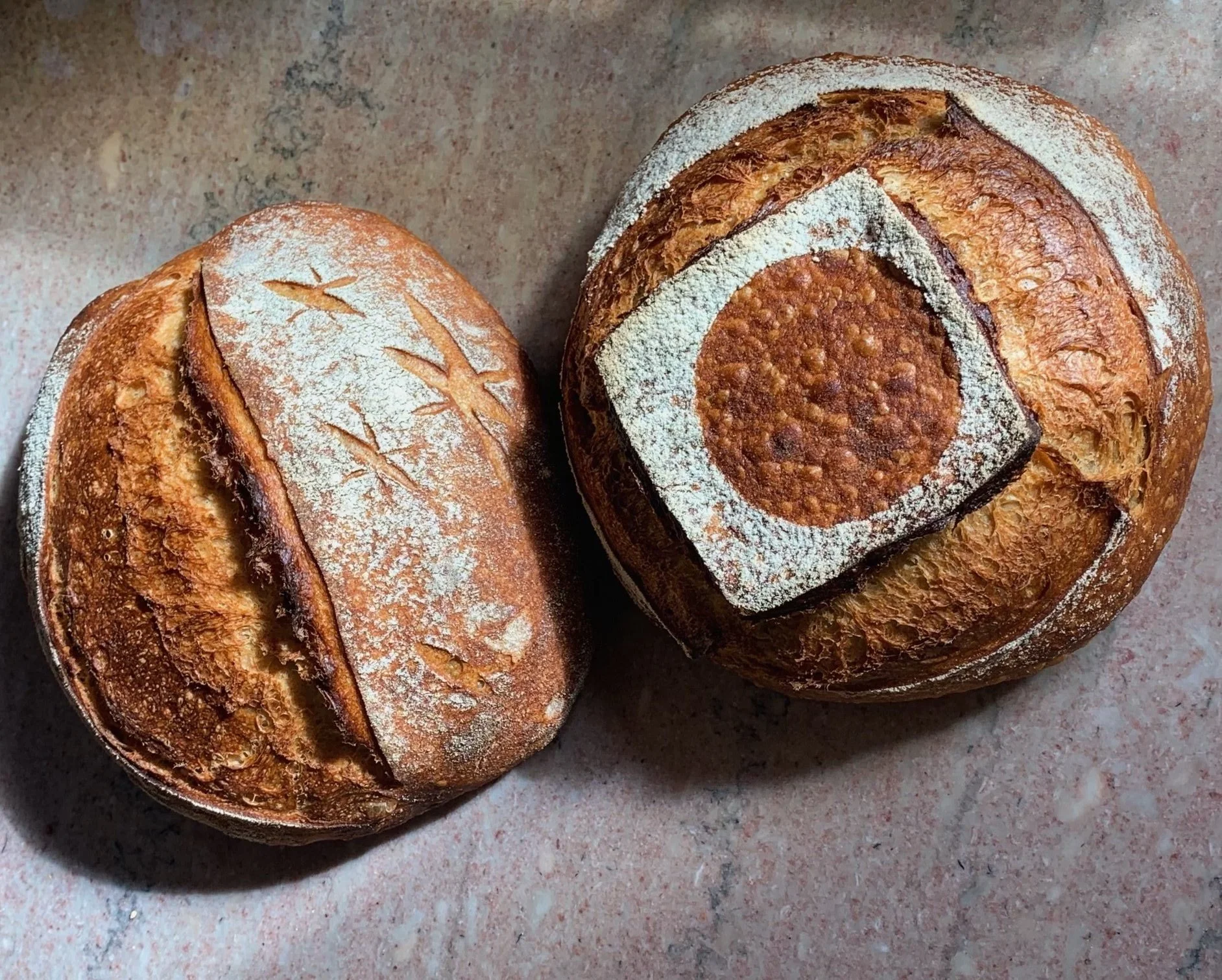
Think of your starter as a pet, or perhaps as a herd, because that’s what it is— millions of bacteria and fungi living in a little jar on your counter! They don’t ask for much, and they’re happy to help you with your baking. Nice deal.
You’ll want to feed your starter or chef every day. Here in the bakery we feed ours twice a day. The important thing is that your herd needs a regular schedule; they don’t like to run out of food, and they don’t like being swamped by too much food all at once.
Here are some practical recommendations: keep your herd at approximately 500g. Each day, throw away 85% of the herd (425g of starter), and replace it with 255g of rye flour and 170g of water. Are these exact amounts important? No. They are approximations that will leave you with a moderately loose mix with sufficient fresh food and sufficient water for your herd to thrive. You will see, as you gain experience, that the way you care for your herd changes the way they work and reproduce. A wetter mix, for example, will generally speed up your herd’s reproduction, and of course, they will eat through your feed a little faster, too. Warmer temperatures will accelerate things as well.
You will want to take care to use water that is approximately 70 degrees F. You can speed up reproduction with warmer water, but our experience shows that your starter will not necessarily be stronger for that, and your flavors can go off. Best is a steady and moderate temperature—neither too hot nor too cold. Here at the bakery, we like the flavors we get when our starter lives in a comfortable 65F all the time.
At the bakery, we use our starter pretty much every day, and it lives it a tiny refrigerator and gets fed twice a day. When I did most of my baking at home I kept my starter in the fridge, and because sourdough microbiota slow down as they get colder, that meant I didn’t have to feed it every day. But that also meant that I had to wake up my starter the day before I started baking. Baking with sleepy starter is no fun, and it’s a good way to end up with “bricks” that are too heavy even for squirrels. So, if you’re going to put your starter to sleep in the fridge during the week, be sure to take it out early. Let it warm up and give it at least two good feedings before you start to bake with it.
It is important to use your starter when it is at its peak. When you feed your starter it quickly begins to ferment. You can see it. You will see the mix swell and bubble. Over a period of 8 to 12 hours the mix will go from a smooth and dense paste to something almost fluffy. You will see bulging on the top of the mass, and you will see the character of its surface change. It will look slightly shiny and convex. It will smell like ripe fruit with a few drops of vinegar.
If we were to ferment this mix in a glass jar, we’d see it rise and swell, reach a peak, and then recede. That peak is what you’re looking for!
If you use your starter when it is too young or too old, your dough will ferment too slowly, and the dough will be difficult to handle and the bread will have poor flavor, color, and rise.
One of the most important arts of baking is TIMING! You will have to figure out when to feed and use your starter in the context of your life.
Let me give you an example: In the bakery, let's say we need bread on a Friday morning. That means we need our doughs to be fermenting well by Thursday at mid-day. That, in turn, means that we’ll need an appropriate amount of the flour to be at its peak fermentation on Thursday morning, and that will require that we start that fermentation late in the evening on Wednesday. In order to assure that the fermentation gets off to a good start on Wednesday, we need to be sure to feed the starter around mid-morning on Wednesday.
We bake a lot, and we feed our starter every day such that it is ready to use in the late evenings when we begin the larger fermentations.
How to put your starter on hold:
Your herd is lively and demanding, but they’re on your side. If you ask them nicely, they will happily take a long nap while you go on vacation. All you need to do is feed them well and then chill them down by putting them in the fridge. Your herd will last almost indefinitely in the refrigerator. As your starter gets older, sitting there in the back of the fridge, it will start to look pretty nasty. It will likely turn black and accumulate a layer of clear liquid. Don’t be scared. It is not dead. To revive it, pour off the “hooch” and scrape a little hole in the skin of the paste beneath. Then take some of the material from the center of the paste and mix it, in a clean bowl or jar, with a small quantity of flour and warm water. Let it sit for 8 hours, then add another quantity of flour and warm water. Wait another 8-12 hours and begin a regular feeding schedule. It’s possible for your herd to die, but it doesn’t happen often. You may hear folks talking about how they “killed” their starter by ignoring it, but I think it’s more likely that they thought it looked too nasty to work with... so they threw it away.
Your starter wants to work with you! Be CURIOUS about your starter. Admire it. Ask questions of it. Be a good partner.
Treat your starter right, and it will treat you right.